Math Visualizations: Animated Factorization Diagrams
Terry VanNoy
PD Specialist
Blog
As the “Teq-math-teacher-guy”, I feel compelled to offer you another math tech related post to help you in your instruction. The website, Data Pointed, is great for teachers working with elementary, middle, or high school level students. If you want a way to visually show your students number patterns and get them interested in the fascinating world of numbers, this site is for you!
Animated Factorization Tool on Data Pointed
Data Pointed has many built-in tools for showing representations of data, including maps, color values, and the factors of numbers. Scroll down a bit to find the one titled, “Animated Factorization Diagrams.”
The idea is that starting with the number 1, we see a picture of the number in dots. It starts automatically and goes forever, but you can stop and control which number is displayed. The play bar appears in the lower right part of your computer screen.

When working with students, I first let the animations play and ask students to look for patterns. What shapes do they see? Is there any order to the shapes they see such as circles, triangles, or squares? The key is to have students think of different predictions or theories for why certain numbers have particular shapes. The role of us, as teachers, is to ask the right questions and give students time to discuss and think about them. I have given expected answers to these questions as a guide below, but please share with us at otis@teq.com if you have other ideas.
Elementary Level
As students learn to count, show a number such as 10 and have them say or write number sentences that equal 10. Students should be able to come to the board and use ink tools to “prove” that 7 + 3 equals 10 (by circling the appropriate dots). When understanding and applying multiplication, you can advance into showing numbers such as 18. Here are some example questions appropriate for elementary-level activities:
- What shapes do you see? Answer: Triangle-like shapes
- Why is the number 18 this shape? Answer: Because of the factors of 18
- Which numbers can divide into 18? Do you see those in the diagram? Answer: 2, 3, 6, and 9
- 9 X 2 is 18. Where is that shown in the picture? Answer: Students can circle a pair of dots, then show how there are nine groups of them.
- How do you know that 6 is a factor of 18? Answer: It shows three groups of six.

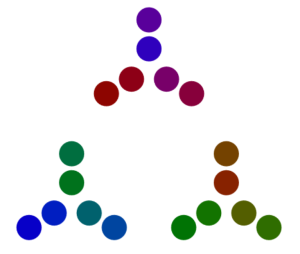
As an added bonus, teachers can use the Screen Shade feature from the SMART Ink Tool to cover up the factorization, which appears in the upper left, or use it to cover the dots and have students predict the number’s shape.
Middle School Level 
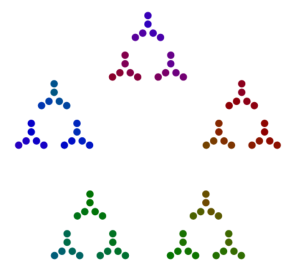
For students learning factors, multiples, and divisibility, teachers can show a number diagram and cover up the factorization. Students can do factor tree diagrams or say what the factorization is, then explain how it is shown in the dot diagram. For example, the number 18 equals 3 X 3 X 2 because we see three groups of two, two groups of three, etc.
- How are the numbers 9, 18, 27, and 90 related? Answer: They are made of similar shapes because they are all multiples of 9.
- Take any number such as 25. Predict the shapes of other numbers that are multiples such as 50 and 75. Why did you make that prediction? Answer: These numbers share common factors.
- What is the greatest common factor of 27 and 90? Answer: 9
- How can you tell from their diagrams? Answer: Look for the largest common shape within each diagram.
High School
With higher levels of math, the Data Pointed website can be helpful to discuss number theory and patterns. One example would be to look at prime numbers vs. composite numbers.
- Let the animations run for a bit (up to 200 or so) and notice some common shapes. Which numbers result in circles? Answer: Prime numbers such as 53.


- Which ones are circles within circles? Answer: Multiples of primes, such as 46 (2 X 23).
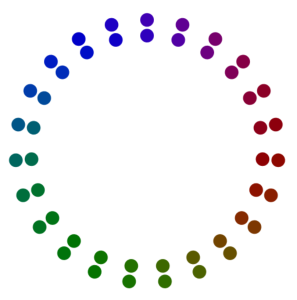
Notice that this pattern shows 23 pairs of dots.
- Can prime numbers ever be consecutive? Why or why not? Answer: No. Other than the number 2, no other primes are even. Students will see some prime numbers two apart from each other, such as 11 and 13 or 59 and 61. These are “twin primes” and can lead into further discussion.
Have fun with the Data Pointed website, as there are plenty of other tools and different ways to use them in your classroom. Share your other ideas and success stories with us by commenting below or emailing OTIS@teq.com. Looking for more math ideas? Check out our Math category on OTIS for educators.
For more tips, tricks, and tools for teaching in and out of the classroom, check out more content on the Teq Talk blog or our YouTube channels OTIS for educators and Tequipment.
We also offer virtual professional development, training, and support with OTIS for educators. Explore the technology and strategies that spark student success — no matter where teaching or learning are happening!
Follow us on social:
 edteq
edteq  OTIS4educators | Teq Products | iBlocks
  OTIS4educators | MyTeq
  Teq
Teq
0 thoughts on “Math Visualizations: Animated Factorization Diagrams”
Related Articles & Other Recommended Reading
Top 10 Ways to Celebrate Pi Day
Did you know that the first official Pi Day celebration occurred in 1988 at the Exploratorium in San Francisco? In America, we celebrate on March 14th because 3.14 are the first digits of the mathematical constant known as pi. However, in areas such as the United Kingdom, people celebrate on July 22nd. Why? This is […]

7 New PD Courses to Transform Your Classroom for February 2026
Get ready for Digital Learning Day on February 26th! Celebrate with 7 brand-new OTIS courses that make edtech integration easy. From AI-driven lesson planning to interactive classroom tools, master the tech your students love, without the steep learning curve. Here are 7 new PD courses to transform your classroom for February 2026! Check Out What’s […]

Check out our PD Micro-Credential: The Science of Reading
Earlier this year, OTIS for educators launched a PD micro-credential focused on “The Science of Reading.” This 10-part online course takes just under eight hours to complete. “The Science of Reading” micro-credential PD provides participants with a solid foundation of the tenets of reading instruction. We will delve into each component, critical for understanding the […]