Enhancing Hands-on Learning with Strawbees
Caylie Gaccione
Curriculum Specialist
News
Will your students become inventors, engineers, or maybe even artists? Our goal, as educators, is to give our students the tools and resources that they need in order to explore all of these career options. Strawbees is a learning tool that gives students the space and materials to create, learn, and grow. So, what is Strawbees and how can we incorporate this product into our daily instruction? Let’s get started enhancing hands-on learning with Strawbees!
Getting started with Strawbees
Strawbees is best defined as a STEAM building and robotics solution. It is a tool that is used to boost creativity across all age groups and educational needs. In the simplest terms, Strawbees uses connectors and building straws that are placed together to build unique creations. Strawbees is hands-on, screen-free, and promotes playful and exploratory learning. Getting started is simple! Here are a few steps for you and your students to begin with:
1) Start with the connectors and straws
There are different sized straws for different projects. Encourage students to have open exploration and play around with the different materials that come in each kit. This is the first step in helping students become comfortable with using Strawbees. Let them explore what is included in the kits without the pressure of making something specific. You’ll be amazed at what your students come up with when you give them the space to create!
2) Begin the building process
The ultimate goal is to look at a picture and then replicate the build. The best way to get started is to follow the step-by-step lesson plan directions. Next, try watching a video and recreate the build based on the video. Finally, look at a picture and create the build from there. This is a great way to help students feel comfortable with making different Strawbees creations!
3) Work your way up to more complex creations
Start using your straws to create angles and simple shapes. Then, add more complexity and create larger structures by connecting the straws and connectors together. You can then advance further with coding, robotics, motion, light, and sensors using micro:bit. A great introductory activity is “Intro: Scissor Linkages,” which is a quick lesson to teach students about simple machines and linkages for mechanical movement. As students advance, try out an activity like “Build a Mega Catapult,” which encourages students to learn about forces and encourages multiple iterations and even the addition of props to test the catapult.
Working with Strawbees Classroom:
Now that we have begun to understand what Strawbees are all about, we are ready to move on to exploring Strawbees Classroom, which is an online platform to support teachers and students by utilizing their Strawbees materials. Let’s dive into some highlights of this interactive platform:
- The Strawbees Classroom dashboard is always updating and changes based on any specific products you have (e.g. micro:bit). On the dashboard, you will also find training, activities for getting started, webinars, spotlight articles, and more.
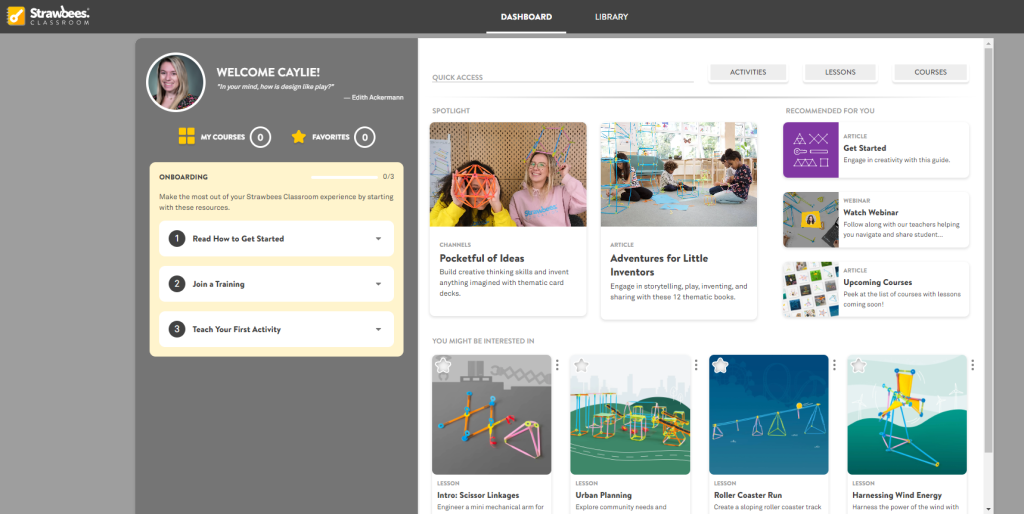
- Within the Library tab, you will see Courses, Lessons, Activities, Teacher Support, and Channels. When you click into each of these categories, you will be able to search and filter by topic, age, grade, and even learning standards. Each resource can be further explored, assigned to students, and added to favorites to view at a later time. The Library is really the heart of Strawbees Classroom and I would definitely recommend taking the time to explore the many resources and activities that it has to offer.
- The lesson plans will consist of several key components to guide you and your students through a Strawbees creation from start to finish. The lesson structure consists of the following sections: Warm-up, Imagine, Create, Build, Reflect, and Challenges. Within each of these sections, you will find the list of required pieces and step-by-step instructions, video tutorials, key vocabulary terms, inquiry-based questions, and more! One of my favorite parts of this section is that it is broken down based on what teachers will see and what students will see once it is shared with them.
More from OTIS
Strawbees Classroom is chock full of resources and tools for educators to support their students’ Strawbees creations from start to finish. I hope that you and your students enjoy exploring Strawbees, getting creative, gaining engineering skills, and engaging in hands-on learning! Be sure to check out our accompanying OTIS course, STEAM Challenges with Strawbees, as well as many other courses in the OTIS Course Library to explore other STEM products.
For more tips, tricks, and tools for teaching in and out of the classroom, check out more content on the Teq Talk blog or our YouTube channels OTIS for educators and Tequipment.
We also offer virtual professional development, training, and support with OTIS for educators. Explore the technology and strategies that spark student success — no matter where teaching or learning are happening!
Follow us on social:
 edteq
edteq  OTIS4educators | Teq Products | iBlocks
  OTIS4educators | MyTeq
  Teq
Teq
0 thoughts on “Enhancing Hands-on Learning with Strawbees”
Related Articles & Other Recommended Reading

Top 10 Ways to Celebrate Pi Day
Did you know that the first official Pi Day celebration occurred in 1988 at the Exploratorium in San Francisco? In America, we celebrate on March 14th because 3.14 are the first digits of the mathematical constant known as pi. However, in areas such as the United Kingdom, people celebrate on July 22nd. Why? This is […]

7 New PD Courses to Transform Your Classroom for February 2026
Get ready for Digital Learning Day on February 26th! Celebrate with 7 brand-new OTIS courses that make edtech integration easy. From AI-driven lesson planning to interactive classroom tools, master the tech your students love, without the steep learning curve. Here are 7 new PD courses to transform your classroom for February 2026! Check Out What’s […]

Check out our PD Micro-Credential: The Science of Reading
Earlier this year, OTIS for educators launched a PD micro-credential focused on “The Science of Reading.” This 10-part online course takes just under eight hours to complete. “The Science of Reading” micro-credential PD provides participants with a solid foundation of the tenets of reading instruction. We will delve into each component, critical for understanding the […]