ENL Family Involvement: Bridging the Gap Between School and Home
Caylie Gaccione
Curriculum Specialist
News
As educators, we know the importance of connecting with both our students and their families. We can teach all of the necessary skills and academics to our students when they are in the classroom, but what happens when they go home? Our goal is to bridge the gap between school and home and make sure that key ideas and concepts are reinforced once students leave the classroom. The way we achieve this is by forming meaningful connections with the families of our students to help us learn about their home lives, cultural backgrounds, values, and so much more.
For English language learners specifically, we want to ensure that we address any specific language needs to provide our students with the best possible learning experience. All of our students are coming to school with diverse needs and backgrounds, and it is our goal as educators to address these individual needs. We also want to consider what we need to do in order to have students speaking and understanding English as quickly and proficiently as possible. Remember that it truly does take a village! Let’s dive into some strategies to help us along the way.
The importance of family involvement
It is important to consider that every student has a unique family structure. As you get to know your students, you may learn that they live with grandparents, aunts and uncles, parents, etc. When involving family members, we want to remember to think about these different family types to help us make informed decisions that will ultimately benefit our students. So, why is family involvement so important?
- Builds connections: By getting to know the families of our students, we are able to learn more about our students, which will, in turn, help us to give them the tools that they need to succeed. It might be as simple as learning about what students and their families like to do for fun on the weekends, holidays that they celebrate, and other important traditions. For our ELLs especially, they might not have the language skills to tell us all of this information while they are at school. By connecting with their families, we will gain new insights.
- Creates an inclusive environment: When you foster a welcoming and inclusive environment, you are opening your classroom doors. This will encourage families to be active participants in the lives of the students. Our goal is, of course, to get families involved. By using welcoming and inclusive language, as well as multiple means of communication, families are more likely to be involved.
- Promotes positive student outcomes: There are several other benefits such as overall well-being, decreased problem behaviors, increased student achievement, and more. When families are involved, they are more likely to assist students with homework and projects which leads to those positive student outcomes. They also are more likely to have meaningful conversations to discuss what is happening both in and out of the classroom.
Strategies for connecting with families
- Be sure to be very explicit when communicating how family members can take an active role in their student’s learning. By giving clear strategies, procedures, and ideas for families to get involved, they will be more likely to take on that active role.
- Go over any translation resources, at home anchor charts, bilingual applications or dictionaries, etc. The first step is providing those materials to families (digital or paper) and then reviewing how to effectively make use of these resources.
- Provide talking points for families to ask students about what they’ve learned, their school day, friends, successes, troubles, etc. Open the lines of communication and use that to gain new insights about your students.
- Make sure that all exchanges, resources, and directions are clear and concise. When working with families, there’s no need to overcomplicate the materials that you are providing. Keep it simple!
- Get family input through open communication to learn more about what is really important to families. This can be in the form of a survey, welcome packet, take home projects, and more! All of these will aid in understanding our students while also boosting their language skills.
- Provide opportunities to learn about home lives, cultural values, and activities to build connections.. In terms of our ENL students, it’s important that we create opportunities that are going to be engaging while also providing educational opportunities.
Specific tools to try
Now that we know a little more about the importance of family involvement and a few different strategies to try, let’s take a closer look at some specific tools to make the process even more seamless!
- Take-home anchor charts: Anchor charts are a great way to take home ideas and concepts learned in school. This can benefit students and families through visuals and vocabulary support.
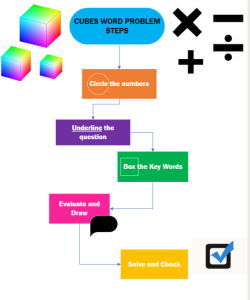
- Informational brochures: Use a brochure (it could be digital) to relay important school-related information. Having all of this information clearly organized takes out any confusion that families might have around school happenings, conferences, testing, etc.
- “Get to know you” questionnaire(s): These questionnaires can be used for students and families alike! Use a Google Form (or other platform) to easily push this out to students and families and gain valuable information.
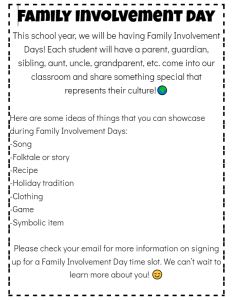
- Family involvement days/workshops: Involvement days and workshops are the perfect way to get families included in classroom activities. Use these days to educate families to teach about school happenings or subject specific topics. Remember that you could even host these events in multiple languages.
I hope these ideas inspire you to connect with the families of your students! Remember to keep it simple and start small. No matter what you do, your students will benefit from the connections that you are fostering to bridge the gap between school and home.
Be sure to check out our accompanying OTIS course, Tools to Support ENL Family Involvement, as well as many other courses in the OTIS Course Library to learn about other pedagogical best practices and resources.
For more tips, tricks, and tools for teaching in and out of the classroom, check out more content on the Teq Talk blog or our YouTube channels OTIS for educators and Tequipment.
We also offer virtual professional development, training, and support with OTIS for educators. Explore the technology and strategies that spark student success — no matter where teaching or learning are happening!
Follow us on social:
 edteq
edteq  OTIS4educators | Teq Products | iBlocks
  OTIS4educators | MyTeq
  Teq
Teq
0 thoughts on “ENL Family Involvement: Bridging the Gap Between School and Home”
Related Articles & Other Recommended Reading

Top 10 Ways to Celebrate Pi Day
Did you know that the first official Pi Day celebration occurred in 1988 at the Exploratorium in San Francisco? In America, we celebrate on March 14th because 3.14 are the first digits of the mathematical constant known as pi. However, in areas such as the United Kingdom, people celebrate on July 22nd. Why? This is […]
7 New PD Courses to Transform Your Classroom for February 2026
Get ready for Digital Learning Day on February 26th! Celebrate with 7 brand-new OTIS courses that make edtech integration easy. From AI-driven lesson planning to interactive classroom tools, master the tech your students love, without the steep learning curve. Here are 7 new PD courses to transform your classroom for February 2026! Check Out What’s […]

Check out our PD Micro-Credential: The Science of Reading
Earlier this year, OTIS for educators launched a PD micro-credential focused on “The Science of Reading.” This 10-part online course takes just under eight hours to complete. “The Science of Reading” micro-credential PD provides participants with a solid foundation of the tenets of reading instruction. We will delve into each component, critical for understanding the […]